Address
7 Bell Yard, London, WC2A 2JR
Work Hours
Monday to Friday: 8AM - 6PM

Address
7 Bell Yard, London, WC2A 2JR
Work Hours
Monday to Friday: 8AM - 6PM


Generative AI is artificial intelligence that creates new content. Give it a text prompt and it writes an essay. Feed it a description and it generates an image. It can produce code, music, videos and more. Unlike traditional AI that analyses data or makes predictions, generative AI builds something original from what it has learned. Tools like ChatGPT and DALL·E have brought this technology into everyday use, but for businesses the question isn’t just what it does. It’s how to use it properly.
This guide explains what generative AI is, how it works, and what makes it different from other types of AI. You’ll see real examples of where it’s being used, understand the benefits and risks, and learn what your organisation needs to implement it safely. Whether you’re exploring AI for the first time or trying to move past failed pilots, this article gives you the practical foundation to make informed decisions about generative AI in your business.
The pace of generative AI adoption has accelerated beyond anything we’ve seen in enterprise technology. ChatGPT reached 100 million users in two months, faster than any application in history. Your competitors aren’t just experimenting anymore. They’re embedding AI into products, automating entire workflows, and serving customers through AI systems that work around the clock. The question for most businesses isn’t whether to use generative AI but how quickly you can implement it without breaking things.
Two years ago, generative AI was a novelty. Today, it’s reshaping how businesses operate at every level. Sales teams use it to draft proposals. Engineers use it to write and review code. Customer service departments handle triple the volume with AI-assisted responses. The technology works well enough now that waiting for perfection means falling behind. Companies that master generative AI today will set the pace in their industries. Those that hesitate will spend years trying to close the gap.
The gap between early adopters and laggards in AI adoption will define market position for the next decade.
Your organisation already produces documents, answers customer questions, and processes information. Generative AI can handle these tasks faster and more consistently than manual processes. But speed alone isn’t the point. The real value comes from freeing your people to focus on work that requires judgement, creativity, and human connection whilst AI handles the repetitive groundwork. That’s why understanding what is generative ai and how to implement it properly matters more now than ever before.
Your first generative AI implementation shouldn’t be mission-critical. Start with tasks where errors are easy to spot and consequences are minimal. This lets your team learn what is generative ai capable of in practice whilst building the guardrails you need for larger deployments. Most organisations stumble because they rush into high-stakes applications before understanding the technology’s behaviour, limitations, and failure modes.
Pick a specific workflow that takes significant time but doesn’t involve sensitive decisions. Content drafting, data summarisation, and internal documentation work well as starting points. Your marketing team can use AI to create first drafts of blog posts. Customer service can generate response templates. Engineers can get help documenting code. These tasks let you measure productivity gains whilst keeping humans firmly in control of final outputs.
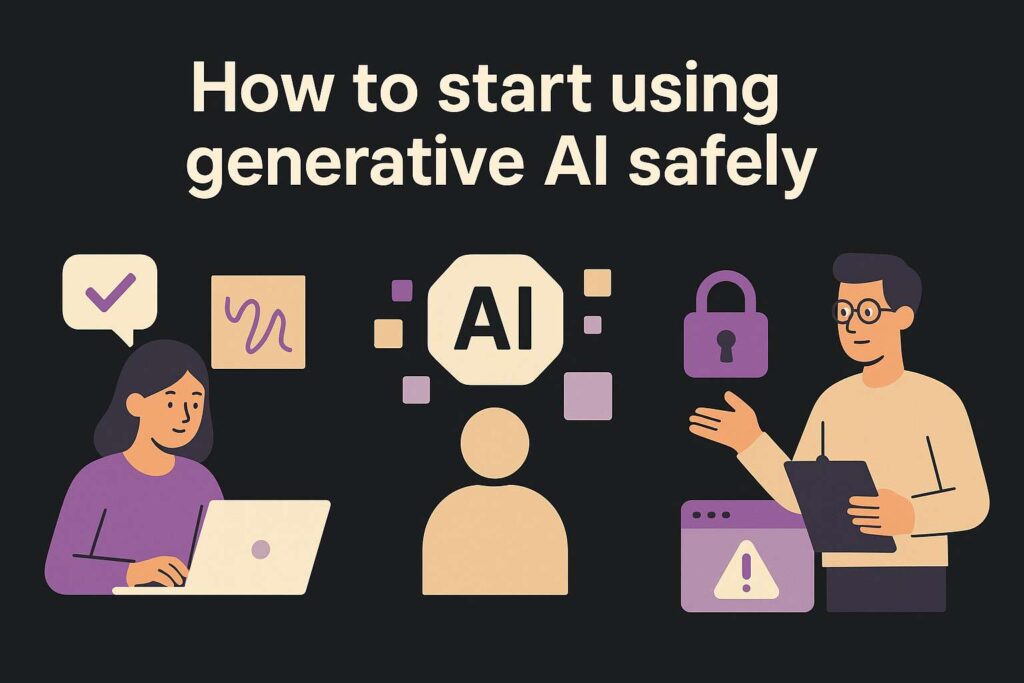
The safest path to AI adoption runs through use cases where human review is natural and straightforward.
Test with a small group first. Give them clear instructions on what AI should and shouldn’t handle. Track both time saved and error rates. This pilot phase teaches you what works in your environment before you scale to the entire organisation.
Never publish AI-generated content without human review. Every output needs verification by someone who understands the subject matter and can spot mistakes, bias, or inappropriate content. Build this check into your workflow from day one. The moment you skip verification to save time, you risk publishing errors that damage your credibility.
Create written policies that specify which tasks AI can assist with, who approves AI outputs, and what information stays out of AI systems entirely. Your team needs to know these boundaries before they start using the tools.
Assume that anything you put into a public generative AI tool could become part of its training data. Never input customer information, proprietary code, financial data, or confidential strategy into systems like ChatGPT or similar public platforms. Treat these tools like you would treat posting on social media.
For work involving sensitive information, you need enterprise solutions with proper data controls, private deployments, or on-premises systems. This costs more but protects what matters. Starting safely means understanding these data boundaries before your team accidentally shares something they shouldn’t.
Generative AI uses neural networks trained on massive datasets to create new content that resembles what it learned during training. Understanding what is generative ai requires looking at both the training phase and the generation phase. During training, the system analyses millions of examples to learn patterns, structures, and relationships in the data. During generation, it applies those patterns to create something new based on your prompt. The output isn’t copied from the training data. It’s synthesised from the statistical patterns the model learned.
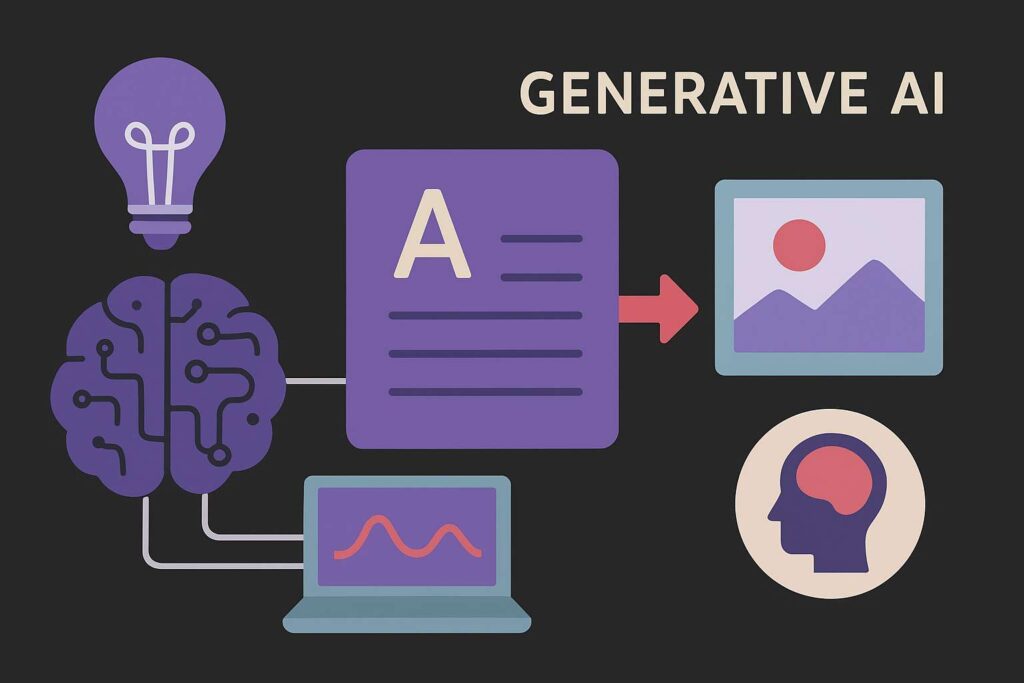
Training a generative AI model starts with feeding it enormous amounts of data. GPT-3 trained on 45 terabytes of text, roughly equivalent to a quarter of the entire Library of Congress. The model doesn’t memorise this content. Instead, it learns how words relate to each other, how sentences form, and what makes coherent communication. Image models like DALL·E train on millions of images paired with descriptions, learning which visual patterns correspond to which concepts.
Modern generative AI models learn patterns from data at a scale that would take humans thousands of lifetimes to process.
The training process adjusts billions of parameters within the neural network. Each adjustment fine-tunes how the model responds to different inputs. This happens through repeated exposure to examples and constant feedback on what constitutes a good output. Better training data produces better models, which is why data quality matters as much as quantity.
When you give a generative AI model a prompt, it doesn’t search a database for answers. It predicts what should come next based on the patterns it learned during training. Text models predict the most likely next word, then the word after that, building responses one token at a time. Image models predict which pixels belong where to match your description.
The model considers context from your entire prompt. Each word influences which words follow, creating coherent outputs that maintain consistency throughout. Temperature settings control randomness in these predictions. Lower temperatures produce more predictable, focused outputs. Higher temperatures increase variety but risk incoherence.
Most powerful generative AI systems use transformer architecture, introduced by Google in 2017. Transformers excel at understanding context because they process all parts of an input simultaneously rather than sequentially. This architecture includes an encoder that converts your prompt into numerical representations and a decoder that turns those representations into output.
Attention mechanisms within transformers determine which parts of the input matter most for each part of the output. When generating text about London, the model pays more attention to words related to cities, geography, and the United Kingdom. This selective focus produces more relevant and accurate outputs than older approaches that treated all input equally.
Different model types serve different purposes. Encoder-only models like BERT excel at classification tasks. Decoder-only models like GPT handle text generation. Encoder-decoder models combine both capabilities. Your choice depends on whether you need the AI to understand and categorise information or generate new content from scratch.
Seeing what is generative ai in practice clarifies how businesses apply the technology to solve real problems. The applications range from creative work and content production to highly technical tasks like code generation and drug discovery. These examples show where generative AI delivers measurable value today, not theoretical benefits years away. Your organisation likely performs several of these tasks already, which means immediate opportunities exist to test the technology in controlled environments.
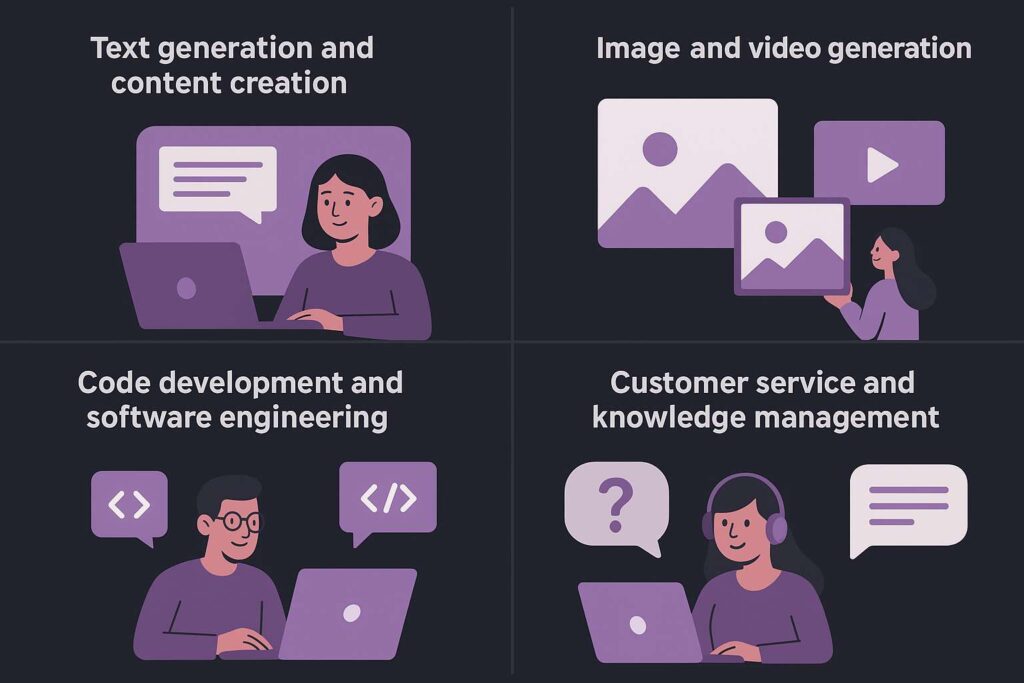
Writing and documentation represent the most common generative AI applications in business today. Marketing teams use tools like ChatGPT to draft blog posts, social media content, email campaigns, and product descriptions. Legal departments generate contract templates and summarise lengthy documents. Human resources teams create job descriptions, policy documents, and training materials. The AI handles first drafts whilst humans refine, fact-check, and add strategic thinking that machines cannot provide.
Translation services have improved dramatically with generative AI. You can translate technical documentation, customer communications, and marketing materials across dozens of languages whilst maintaining tone and context. Customer support teams use AI to draft personalised responses based on ticket history and knowledge bases. The technology adapts writing style to match your brand voice when properly trained on your existing content.
Visual content creation through tools like DALL·E, Midjourney, and Stable Diffusion lets businesses produce custom imagery without photographers or graphic designers for every need. Marketing teams generate product mockups, social media graphics, and advertising concepts. Architects and interior designers create visualisations of spaces before construction begins. The technology works particularly well for rapid prototyping and iteration where you need multiple variations quickly.
Generative AI transforms visual workflows from days of production time to minutes of refinement time.
Video generation remains less mature but advancing quickly. You can create synthetic training videos, product demonstrations, and personalised video messages at scale. Realistic avatars now deliver presentations in multiple languages without filming new footage. These applications reduce production costs whilst increasing the volume and variety of content you can produce.
Software development has embraced generative AI faster than most industries. GitHub Copilot and similar tools suggest code completions, write entire functions, and explain what existing code does. Developers spend less time on boilerplate code and more time solving complex problems. The AI assists with debugging, test generation, and documentation that developers often delay or skip entirely.
Code translation between programming languages accelerates modernisation projects. Legacy systems written in outdated languages can generate equivalent code in modern frameworks, reducing manual rewriting time from months to weeks. DevOps teams use AI to generate configuration files, deployment scripts, and infrastructure-as-code templates that follow best practices consistently.
AI chatbots and virtual assistants now handle tier-one customer support enquiries with accuracy that rivals human agents. These systems draw from your knowledge base, previous tickets, and product documentation to provide immediate answers. You reduce wait times whilst freeing human agents to handle complex issues requiring empathy and creative problem-solving.
Internal knowledge management benefits equally. Employees ask questions and receive answers synthesised from company documentation, policies, and historical decisions. Retrieval-augmented generation (RAG) systems connect generative AI to your specific data, ensuring responses reflect your organisation’s information rather than generic internet knowledge. This application proves particularly valuable in large enterprises where information spreads across multiple systems and departments.
Understanding what is generative ai means recognising both its transformative potential and its genuine constraints. The technology delivers measurable business value when implemented properly, but it comes with risks that demand active management and limitations that won’t disappear through better prompts or larger models. Your organisation needs clear visibility into both sides before committing resources to deployment. Success requires honest assessment rather than hype-driven expectations.
Productivity gains stand out as the most immediate benefit. Your teams complete tasks in hours instead of days, producing first drafts that would otherwise require starting from blank pages. Customer service departments handle significantly higher volumes without proportional staff increases. Engineering teams ship features faster because AI assists with routine coding tasks. These aren’t marginal improvements. Early adopters report 30-50% time savings on content creation, documentation, and customer support workflows.
Cost reduction follows productivity. You reduce agency fees for basic content, lower translation costs, and decrease the time senior staff spend on routine documentation. Scaling becomes easier because AI maintains consistent quality across unlimited outputs whilst human quality varies with fatigue and workload. Your business can test more ideas, serve more customers, and explore more markets without linear cost increases.
The compound effect of small efficiency gains across multiple workflows transforms how organisations allocate their most valuable resource: human attention.
Hallucinations represent the most dangerous risk. Generative AI confidently states false information that sounds entirely plausible, making errors difficult to spot without subject matter expertise. You cannot eliminate this behaviour through better training or prompting. Medical, legal, and financial applications demand extreme caution because wrong information in these domains causes real harm. Every output requires human verification, full stop.
Data privacy and security risks multiply when employees input sensitive information into public AI tools. Confidential customer data, proprietary strategies, and internal communications can leak into training datasets or become accessible through prompt injection attacks. Your organisation needs strict policies and technical controls before widespread adoption.
Computational costs remain substantial for anything beyond basic use cases. Training large models requires millions in infrastructure, placing custom models beyond most organisations’ reach. Even inference costs add up quickly at scale. Context windows limit how much information the AI considers when generating responses. The technology cannot reason about what it hasn’t seen in training data, making it poor at genuine innovation or handling completely novel situations that require logical deduction rather than pattern matching.
Understanding what is generative ai and implementing it successfully requires preparation that most organisations underestimate. Your technical infrastructure needs work, but human readiness matters more than hardware. The companies that extract genuine value from AI invest heavily in data foundations and team capabilities before deploying any models. Rushing implementation without this groundwork produces failed pilots, wasted budgets, and sceptical employees who resist future AI initiatives.
Your generative AI outputs will only match the quality of data feeding them. Conduct a thorough audit of where your critical information lives and how accessible it is. Customer data scattered across multiple systems, documentation buried in shared drives, and knowledge trapped in individual email inboxes all limit what AI can achieve. You need structured, searchable, and properly labelled information before AI can learn from it or reference it effectively.
Data governance becomes non-negotiable when AI enters your organisation. Establish clear ownership, access controls, and quality standards for each data source. Remove outdated information, fix inconsistencies, and create proper metadata. This preparation work takes weeks or months but prevents AI systems from confidently delivering wrong answers based on obsolete or contradictory sources.
Your teams need practical understanding of AI capabilities and limitations before they touch any tools. Run hands-on workshops where employees test generative AI on real work tasks in safe environments. Let them discover what works and what fails. This experiential learning builds realistic expectations faster than presentations or documentation.
Teams that understand AI’s limitations use it more effectively than those sold on overhyped capabilities.
Identify and train AI champions within each department who understand both the technology and their team’s specific workflows. These advocates help colleagues adopt AI properly whilst spotting misuse or unrealistic expectations early. Your legal, compliance, and security teams need deeper training on risks, regulations, and proper safeguards. Building this distributed expertise ensures sustainable implementation rather than dependence on a single AI team that becomes a bottleneck.
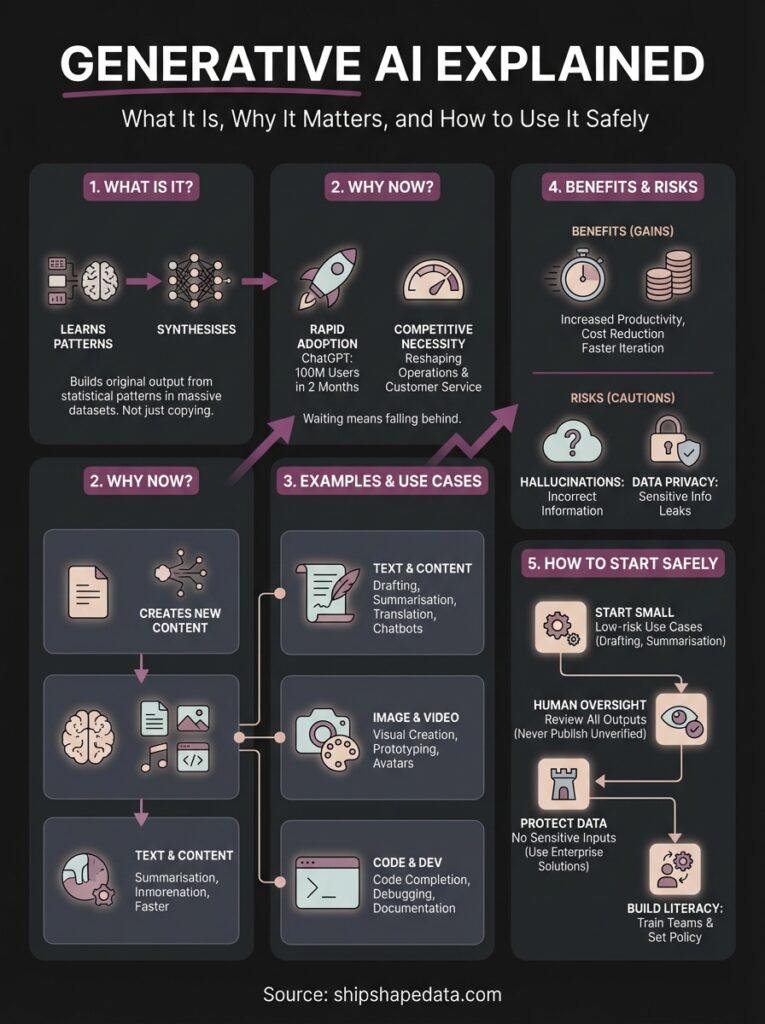
You now understand what is generative ai, how it functions, and where it delivers genuine business value. The technology creates content, assists teams, and automates workflows that previously required significant human time. Implementation success depends on starting small, protecting sensitive data, and maintaining human oversight of all outputs. Your organisation needs solid data foundations and trained teams before scaling AI across operations.
Most businesses struggle not because the technology fails but because they lack the data structure, governance, and technical expertise to implement it properly. Moving from interesting pilots to production systems requires honest assessment of your current capabilities and systematic preparation of both infrastructure and people.
Shipshape Data helps organisations assess AI readiness, prepare data for production use, and implement generative AI systems that deliver measurable results. Whether you need to evaluate your starting position or move stalled pilots into production, proper foundations transform AI from an expensive experiment into a competitive advantage that compounds over time.