Address
7 Bell Yard, London, WC2A 2JR
Work Hours
Monday to Friday: 8AM - 6PM

Address
7 Bell Yard, London, WC2A 2JR
Work Hours
Monday to Friday: 8AM - 6PM


Private equity firms are being asked to create value faster, with greater certainty and less risk. AI can help, but only when it is applied to the realities of portfolio operations, not treated as an experimental technology.
Shipshape Data works with private equity firms to deploy AI that improves portfolio performance, strengthens visibility and supports repeatable value creation. We focus on commercially grounded use cases, reliable data foundations and operating models that scale across investments.

AI creates value in private equity when it improves visibility, speed and control across the investment lifecycle.
A consistent, near real-time view of operational and financial performance across portfolio companies. AI highlights trends, anomalies and underperformance, enabling faster intervention.
Create proprietary AI systems unique to each portfolio company, embedding operational intelligence that strengthens competitive advantage and increases value at exit.
AI accelerates diligence by analysing financials, contracts, operational data and unstructured documents at scale. This improves confidence while reducing time and manual effort.
Surface early warning signals across financial, operational and compliance data. AI helps spot risk before it becomes a value-eroding event.
Identify inefficiencies across procurement, headcount, supply chain and operations within and across portfolio companies.
AI helps build clearer, evidence-backed narratives around performance, resilience and growth at exit.
Many private equity firms see the potential of AI, but few manage to turn it into consistent portfolio impact. Not because the technology is immature, but because the fund and portfolio operating model is rarely designed to support it.
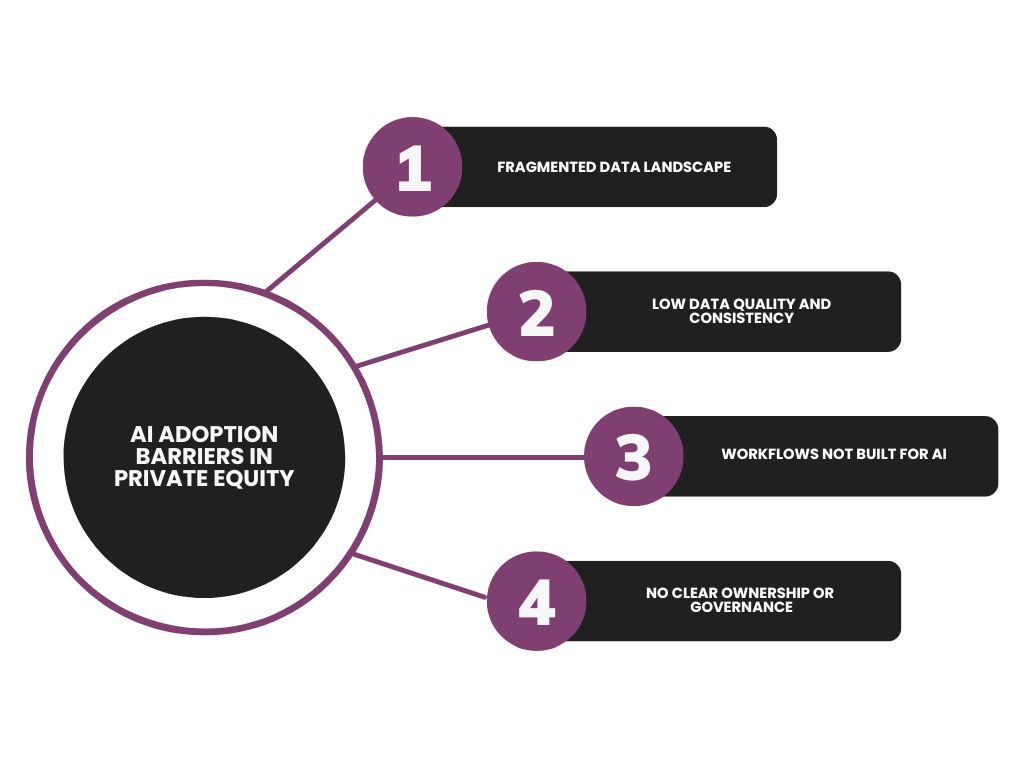
Portfolio companies operate different systems, reporting structures and KPIs. Financial, operational and commercial data is inconsistent across assets, making it difficult to build a unified, trusted view of performance.
Some portfolio companies are data-rich, others rely on spreadsheets and manual reporting. AI models struggle when data maturity varies widely, leading to uneven results and limited scalability.
AI insights often sit outside investment committee, operating partner or board workflows. When outputs are not embedded into decision-making processes, AI becomes informational rather than impactful.
Responsibility for AI sits between the fund and portfolio leadership teams. Without clear ownership of data, outcomes and accountability, initiatives lose momentum and fail to scale.
AI should support value creation, not add technical overhead.
Our approach focuses on delivering tangible results that can be applied consistently across portfolio companies while keeping risk tightly controlled.
Value discovery
We identify where AI can materially improve returns, accelerate value creation or reduce portfolio risk. Focus is placed on EBITDA impact, operational leverage and repeatability.
Data readiness assessment
We assess portfolio data maturity across financial, operational and unstructured sources. This defines what is viable now and what foundations are required to scale.
Use case prioritisation
We select use cases based on commercial impact, feasibility and relevance across multiple assets. Only initiatives that justify investment and scale potential move forward.
Build and integrate
AI is embedded into existing reporting, operating partner workflows and governance processes. Outputs are designed to support real decisions, not standalone dashboards.
Portfolio rollout
Proven use cases are deployed across suitable portfolio companies. Delivery follows a consistent model with shared metrics, controls and oversight.
Ongoing operation and refinement
AI systems are monitored, governed and continuously improved. As the portfolio evolves, models, data and use cases adapt with it.
AI should support sharper decisions, faster intervention and repeatable value creation. This is how we help private equity leaders apply AI with commercial discipline across the portfolio.
Clear, timely visibility into portfolio performance, emerging risk and value creation progress.
AI helps move conversations from lagging reports to forward-looking insight that supports confident investment and exit decisions.
Faster insight across portfolio companies, with fewer blind spots.
AI highlights where performance is drifting, where intervention is needed and which levers will have the greatest impact, without increasing manual analysis.
Practical AI support that improves day-to-day operations without adding reporting burden.
Insights are embedded into existing workflows, helping management teams act earlier and operate more effectively.

Get a leadership-level view of whether your data, systems and operating model are ready to support AI in manufacturing environments.
When focused on the right use cases, value often appears within the first reporting cycle.
No. We design approaches that adapt to varying levels of maturity.
All solutions follow strict access control, governance and security standards.
Ownership is defined upfront to ensure accountability and momentum.
No. AI works best as an ongoing capability that evolves with the portfolio.
AI use cases are prioritised based on speed to value. Many are designed to deliver impact within months, not years, and continue compounding value through the hold period and into exit preparation.
No. We design and operate AI systems as a managed capability, reducing reliance on scarce internal expertise while ensuring continuity and control.
Yes. Not every portfolio company needs the same solution. We identify where AI will deliver the highest return and deploy selectively, with the option to scale proven use cases over time.
AI helps create a clearer, data-backed narrative around performance, resilience and operational control. This supports diligence, reduces uncertainty and strengthens equity stories at exit.
Minimal. Most work happens behind the scenes. AI is integrated into existing systems and workflows, avoiding major change programmes or operational downtime.
We design flexible architectures that work across varying levels of maturity, from spreadsheet-heavy businesses to data-rich enterprises, without forcing uniformity upfront.
It works for both. The approach scales to portfolio size and complexity, with use cases and governance tailored to the fund’s operating model.
Insights are embedded into existing reporting and review processes, supporting faster diagnosis, prioritisation and intervention rather than adding new tools to manage.
The main risk is deploying AI without clear ownership, governance or commercial focus. Technology risk is secondary to operating model risk.
A short discovery or readiness assessment to identify where AI can realistically improve returns, visibility or risk control within the portfolio.