Address
7 Bell Yard, London, WC2A 2JR
Work Hours
Monday to Friday: 8AM - 6PM

Address
7 Bell Yard, London, WC2A 2JR
Work Hours
Monday to Friday: 8AM - 6PM


AI in manufacturing has moved past experimentation. The leaders in the sector now treat it as core operational infrastructure. They use it to stabilise production, raise quality, reduce downtime and gain tighter control over cost drivers.
Shipshape Data helps manufacturing organisations deploy AI in ways that deliver measurable operational and financial outcomes, not theoretical potential.

AI only creates value when it works with the reality of your plants and processes. We help you unlock performance from the systems, data and assets you already have.
Fewer breakdowns, higher uptime and smarter use of engineering time.
We use your existing sensor, maintenance and operations data to predict failures early, surface degradation patterns and help teams plan interventions during low-impact windows.
Stronger service levels with lower inventory risk.
We connect procurement, demand, supplier and inventory data to improve forecasting accuracy, highlight exposure and provide a clearer picture of material flow.
Higher throughput without additional capital expenditure.
By analysing how work actually moves through your plants, we pinpoint bottlenecks, friction and improvement levers that offer the highest return.
Reduced operating cost and more transparent sustainability metrics.
We link energy usage with production behaviour to identify waste, optimise run schedules and improve reporting accuracy.
More yield from the same inputs.
Our models highlight the drivers of scrap, rework and variation. We help you refine recipes, settings and processes within agreed quality limits.
Faster issue detection and more stable operations.
We provide a unified, real-time view of key indicators so teams act on early warning signals instead of historic reports.
Clearer investment decisions and fewer surprises.
We consolidate data across plants into consistent executive-level performance intelligence, highlighting trends, risk and opportunity.
Many manufacturers want to use AI, but few manage to get it working across plants. Not because the technology is out of reach, but because the operating environment is far more complex than most AI vendors acknowledge.
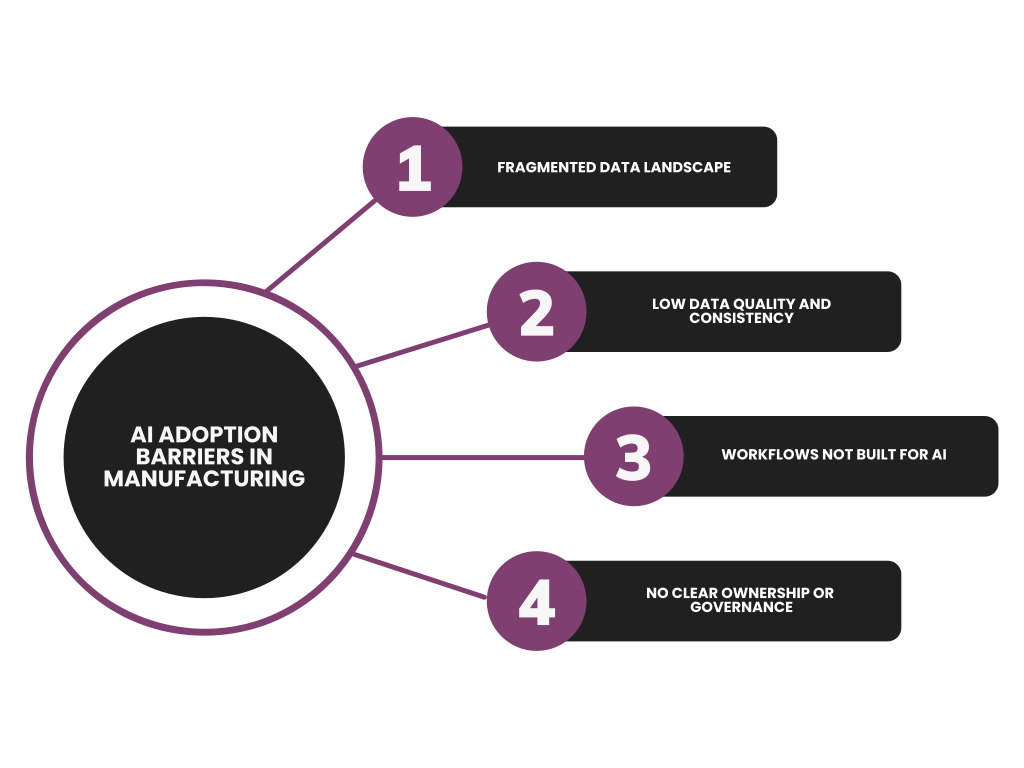
Production data lives in MES, SCADA, ERP, historians and spreadsheets, often in different formats per site. AI has to reconcile conflicting versions of the truth, so models stay fragile and hard to trust.
Plants generate huge amounts of machine and sensor data, but much of it is noisy or incomplete. When models rely on poor-quality inputs, predictions become unstable and engineering teams quickly lose confidence.
AI only helps when insights reach operators at the moment they can act. If outputs sit in dashboards, reports or separate tools, AI becomes an expensive side project rather than part of day-to-day operations.
AI responsibility is often split between IT, engineering and operations. Without a single owner for data, accuracy and outcomes, initiatives lose momentum and rarely progress beyond a promising pilot.
We approach AI as an operational capability, not a technology project. Our delivery model is designed to produce results that scale across your business.
Commercially focused discovery
We start by understanding your operation, not your technology. We identify where cost, risk or inefficiency sits in the business and align your AI programme to those priorities.
Data foundation and readiness
We assess how your data is structured, where it lives and how reliable it is. We then design a data foundation that makes your operational systems usable for AI.
Use case selection and prioritisation
We select initiatives based on business value, not novelty. Each use case is assessed for financial impact, feasibility and scalability.
Build and integration
We develop AI solutions that integrate with your existing production systems. AI is deployed into your real workflows, not kept in a test environment.
Scale across sites
We design solutions with roll-out in mind. Successful use cases are replicated across plants with shared metrics and governance.
Ongoing management and improvement
AI systems require monitoring and refinement. We provide continuing support to maintain performance as your business evolves.


Partner & Country GM, Slimstock

If you carry responsibility for output, margin or delivery, AI should be working for you. This is how we help manufacturing leaders apply it with commercial purpose.
AI gives you visibility into what is slowing your business down before it becomes a financial problem. It highlights operational risk, identifies where efficiency is being lost and shows where improvement will have the greatest commercial return.
Shipshape helps you use AI to stabilise output, reduce downtime and gain clearer control over cost drivers, so performance becomes predictable rather than reactive.
The result:
Greater operational stability, stronger margins and informed capital decisions.
AI helps you spot issues while they are still small. It highlights emerging equipment risk, quality drift and performance loss as it happens, not days later in reports.
Shipshape connects your production data into a single picture so problems surface early and root causes are easier to identify, reducing firefighting and unplanned downtime.
The result:
Fewer disruptions, better-quality output and more consistent day-to-day performance.
AI helps you turn fragmented data into an asset that the business trusts and uses. It replaces disconnected systems and manual reporting with structured, governed intelligence.
Shipshape helps you deploy AI that works within your existing architecture, supports enterprise security standards and scales cleanly across plants and systems.
The result:
Simpler architecture, stronger data confidence and AI that adds value without increasing risk.
AI helps you anticipate disruption instead of reacting to it. It improves forecast accuracy, highlights supplier risk early and gives you clearer control over material flow.
Shipshape applies AI across demand, inventory and supplier data so you can adjust before shortages or excess stock impact service levels or cost.
The result:
Improved continuity of supply, lower inventory exposure and stronger supplier control.

Get a leadership-level view of whether your data, systems and operating model are ready to support AI in manufacturing environments.
AI typically delivers value fastest in maintenance, quality control, production planning, energy management and supply chain operations. These areas combine high cost exposure with good data availability, making them well suited for early results.
When use cases are well chosen and data readiness is addressed early, manufacturers usually see measurable impact within the first 90 days. Broader operational transformation follows through phased rollout.
No. We design AI to work with your existing environment. Enterprise systems such as ERP, MES and maintenance platforms remain the foundation. AI improves how information is used, not where it lives.
We prioritise minimal disruption. Most data work and system integration runs in parallel to daily operations. Live deployment is managed carefully to avoid impact to production schedules.
The biggest risk is not data security or technology. It is deploying AI without ownership, direction or governance. We focus on ensuring every initiative is commercially justified and operationally manageable.
We operate within enterprise security standards. Data access, permissions and architecture are designed with your IT and security teams from day one.
Only where it adds value. AI is embedded into existing workflows wherever possible. Training focuses on insight and action, not software complexity.
AI performs best when treated as a core operational capability. We provide support beyond deployment to ensure accuracy, reliability and continuous improvement.
We never move directly to large-scale deployment. We begin with defined use cases and measurable outcomes, then scale once value is proven.
A short readiness discussion is usually enough to determine where value is most likely and what the obstacles are. From there, we define a practical roadmap.